TruCare

New Home Sleep Test Codes for 2027, Payer Policies, Compatible Devices and How to Bill Them?

Hamza RehmanNovember 25, 2026Healthcare
New Home Sleep Test Codes for 2027, Payer Policies, Compatible Devices and How to Bill Them?

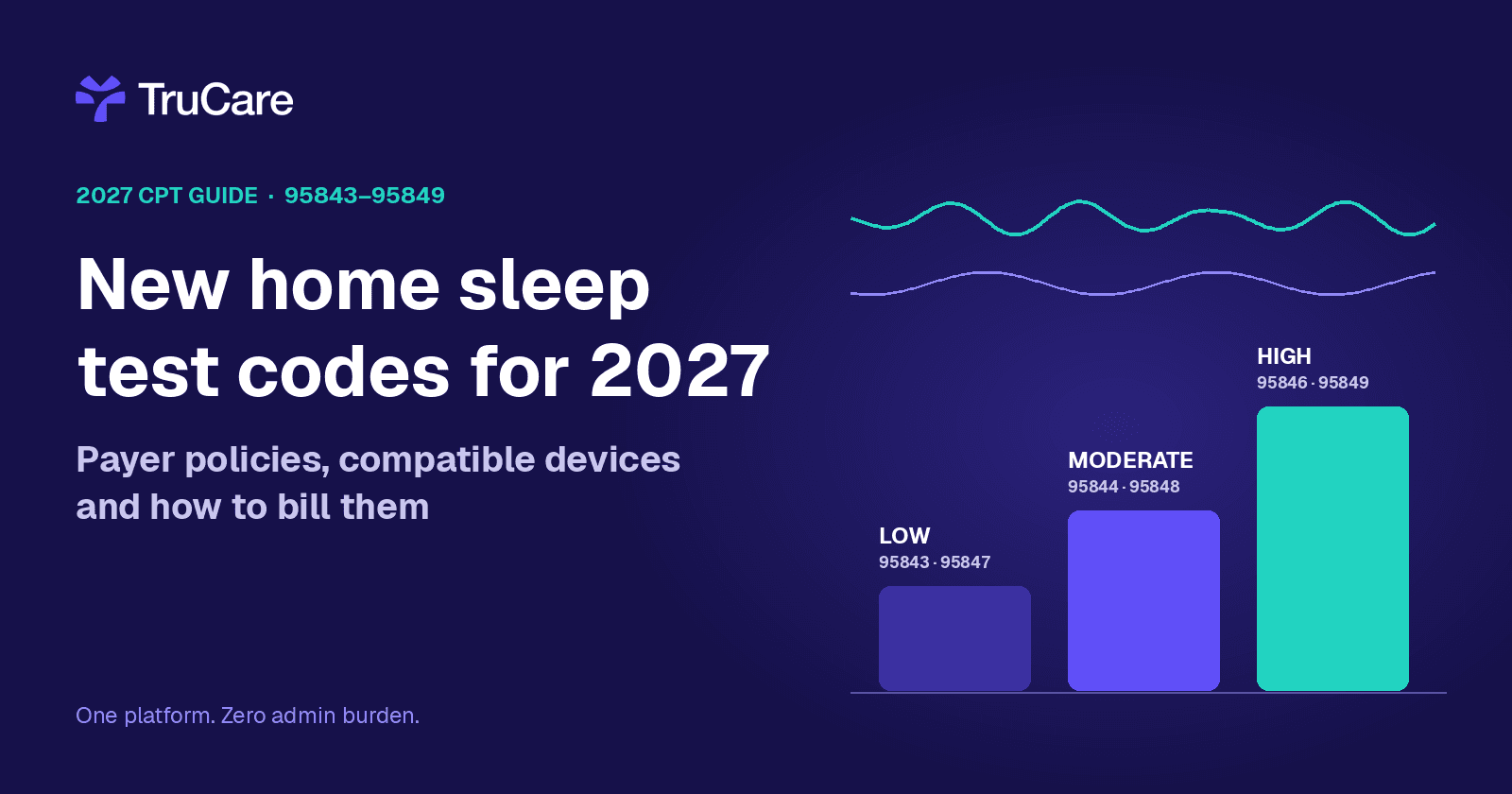
On January 1, 2027, home sleep testing gets new codes. Three codes go away and six replace them. The new codes don't care much which device you used. They pay for what the study captured and what the physician reported.

If you run a sleep practice, a telehealth sleep program, a home testing service or a pulmonology group that orders home sleep tests, this hits your revenue, your workflows and maybe your device contracts. Here's what we know as of late November 2026.

What's changing

CPT 95800, 95801 and 95806 are deleted for dates of service on or after January 1, 2027. Medicare's home sleep test G-codes, G0398, G0399 and G0400, are deleted for 2027 too. Six new codes replace them, sorted by study complexity and split between the technical test and the physician's interpretation. In-lab polysomnography codes like 95810 and 95811 aren't changing.

The new codes

Complexity

Technical code

Professional code

Channels

Parameter categories

Low

95843

95847

3–4

3–5

Moderate

95844

95848

5–10

6–8

High

95846

95849

11 or more

9 or more

The technical codes cover setup, data acquisition and technical analysis. The professional codes cover the physician's or other qualified professional's interpretation and report. Each code describes one piece only, so you generally don't add modifier 26 or TC.

Think of your sleep study as a wedding band. Under the old system, you paid a band by its type. A trio got one rate, a five-piece got another, whatever they played.

Under the new system, the band gets paid on two counts: how many instruments actually played, and how many different songs they performed. The pay is set by the lower of the two.

A ten-piece band that plays three songs gets paid like a three-song band. A solo guitarist who plays 40 songs is still a one-instrument act. Instruments left in the van don't count, even if the band brought them.

That's the 2027 rule. Channels are the instruments. Parameter categories are the songs. The level is whichever count is lower. And only clinically relevant information counts, not everything a device can record.

Payment Rules

The lower count wins. A study with nine channels but only seven parameter categories stays in the moderate tier, because seven caps it.

Related measures count once. AHI, RDI and REI count as one parameter category, not three. Listing every respiratory index won't move you up a tier.

Short recordings get reduced. Modifier 52 applies when a recording runs under 4 hours for low and moderate studies, or under 6 hours for high.

One more thing. Both counts come from the interpreting physician's report. If the report leaves a category out, it doesn't count, even if the device recorded it.

What Medicare will pay

CMS set the high-complexity interpretation code, 95849, at 1.50 work RVUs, up from the proposed 1.42 and below the RUC's 1.60.

Approximate 2027 national Medicare amounts, before geographic adjustment:

Tier

Technical

Professional

Low

about $46 (95843)

about $38 (95847)

Moderate

about $75 (95844)

about $51 (95848)

High

about $146 (95846)

about $72 (95849)

Moving from moderate to high nearly doubles the combined payment. That's the number practices with home PSG should look at first.

Two other CMS decisions matter. CMS reviewed about 800 invoices and still wasn't convinced disposable devices are more typical than reusable ones, so the moderate technical rate assumes reusable equipment. If your program runs on single-use devices, check your margins.

CMS also maps old 95800 to the low codes and old 95806 to the moderate codes for 2027 rate-setting. That's a payment assumption, not a coding rule. You still code each study by what it captured.

Where common devices are likely to land

No payer or regulator publishes an approved or rejected device list. The tier comes from what each study records and what the report includes. These estimates are based on what each device can record. Confirm with your device maker before you build billing rules.

The general pattern: most Type 3 devices should land in moderate, most Type 2 in high and most Type 4 in low, as long as each study meets the code's requirements.

Home sleep apnea test devices

Device (maker)

What it records

Likely tier

WatchPAT 300 / WatchPAT One (ZOLL Itamar)

Up to 7 channels: PAT signal, heart rate, oximetry, actigraphy, body position, snoring and chest motion

Moderate with optional sensors, low without them

Nox T3 / T3s (Nox Medical)

Type III: nasal airflow, effort belts, oximetry, heart rate, position, snoring

Moderate, possibly higher with added sensors

ApneaLink Air (ResMed)

Type III with airflow, effort, oximetry and heart rate

Moderate

Wesper Lab (Wesper)

Chest and abdomen patches plus a finger pulse oximeter

Moderate

ApneaTrak (Cadwell)

Cadwell lists every model at moderate capability

Moderate

NightOwl (ResMed)

Finger-worn, PPG-based, disposable

Likely low

Sunrise (Sunrise SA)

A chin sensor that measures jaw movement for respiratory effort

Unclear, depends on channels reported

SleepImage ring (SleepImage)

Algorithm-derived through cardiopulmonary coupling

At risk, see below

Home PSG and EEG-capable devices

Device (maker)

What it records

Likely tier

Onera STS (Onera Health)

Four wireless patches capturing EEG, EOG, chin and leg EMG, ECG, airflow, respiratory effort, body position, snoring and SpO2

High

Nox A1 / A1s (Nox Medical)

Full wireless PSG recorder, up to 26 channels

High, with the full montage reported

WatchPAT 400 + PolySense (ZOLL Itamar)

Up to 11 channels and 9 parameter categories with the full kit, available in the US in early January 2027

High, right at the threshold

Somfit (Compumedics)

Forehead EEG with deep-learning sleep staging, plus oximetry and pulse

Low to moderate

Sleep Profiler (Advanced Brain Monitoring)

Forehead EEG, EOG and EMG, with respiratory add-ons available

Low to moderate, higher with add-ons

Dreem 3S (Beacon Biosignals)

Five-channel EEG, PPG, respiration and an accelerometer on a headband

Uncertain

Prodigy (Cerebra)

EEG-based home sleep system

Not confirmed

Devices most at risk of not getting paid

Anything under 3 clinically relevant channels has no code. The low tier starts at 3.

Screening and consumer devices don't qualify. The AASM says not to report the new codes for prescreening or consumer-grade devices. Aetna has historically treated the SleepImage Sleep Quality Screener and SNAP testing with fewer than three channels as experimental. That's an older policy, so check it again.

Research and wellness headbands like Muse, ZMax and Somnee aren't cleared for diagnosis.

EEG headbands used outside sleep apnea can qualify for a code and still get denied for coverage. TRICARE West, for example, covers home sleep studies only for an OSA diagnosis, not central sleep apnea, parasomnias or other complex sleep disorders.

Where payers stand

Most major payers haven't published anything yet.

Payer

Status

Medicare

Final. New codes and values adopted, G-codes deleted.

Anthem / Elevance (Carelon)

Adopted. Carelon's sleep guideline adds the six new codes and removes 95800, 95801 and 95806 effective January 1, 2027.

UnitedHealthcare

Not published. Its latest sleep studies policy, effective July 2026, didn't add the new codes.

Aetna

Not published.

Cigna

Not published. Cigna runs sleep prior auth through EviCore, so watch EviCore's code lists.

TRICARE West (TriWest)

Not updated. Its ordering guide still lists 95800 and 95806.

Expect late-December bulletins. Also expect prior auth mismatches in January, where an authorization approved under an old code is attached to a claim billed under a new one.

Who bills what when the work is split

A lot of home sleep programs split the work. One organization provides and analyzes the device, and an independent or telehealth physician reads the study. The new codes make that clean on paper. Technical codes are billed only by whoever does setup, data acquisition and technical analysis, and professional codes only when a physician or other qualified professional interprets.

In practice, both sides have to agree on the tier, because both codes should match the same study. If the reader's report has fewer categories than the device captured, the technical side drops too. Put the tier decision in your reading agreements.

What to finish before January 1

  1. Inventory every device you use and map each setup to its likely tier. Get written tier statements from your device makers.

  2. Rebuild your interpretation templates so every clinically relevant parameter category is reported. This is the biggest lever on payment.

  3. Load the new codes and rates. End-date 95800, 95801, 95806 and the G-codes for 2027 dates of service.

  4. Add scrubber rules for the lower-of-two logic, the modifier 52 recording-time thresholds, and tier matching between technical and professional claims for the same study.

  5. Update prior auth workflows so requests for 2027 dates use the new codes.

  6. Check disposable-device margins against the 2027 rates.

  7. Train sleep techs, schedulers, readers and billers on the lower-of-two rule. Show them Gravy if it helps.

  8. Watch January remits closely and escalate denial patterns early.

How to track payer policies on new Home Sleep Test codes for 2027?

Here are the payer pages we are tracking for policies:

For reference on the code change itself:

What this means for your practice

The new codes pay more for complete, well-documented studies and less for thin ones. Practices with home PSG have real upside in the high tier. Practices built on minimal devices or disposable economics need to run their numbers now.

Almost everything that protects your revenue can be done before January 1. TruCare can map your devices to tiers, rebuild your report templates, set up your billing rules and track payer policies as they publish.


Frequently asked questions

What replaces CPT 95800, 95801 and 95806 in 2027?

Six new codes, starting January 1, 2027. The technical codes are 95843 (low), 95844 (moderate) and 95846 (high). The professional codes are 95847 (low), 95848 (moderate) and 95849 (high).

Are the Medicare G-codes for home sleep testing still valid?

No. G0398, G0399 and G0400 are also deleted for 2027.

How do I pick the right complexity level?

Count the clinically relevant channels recorded and the parameter categories in the interpretation report. The lower of the two sets the level.

Does every signal my device records count as a channel?

No. Only clinically relevant channels count, not everything the device can record.

Do AHI, RDI and REI count as separate parameter categories?

No. They're in the same category, so together they count as one.

Do I still use modifier 26 or TC?

Generally no. Each new code already describes only the technical or the professional part.

When do I use modifier 52?

When a recording runs under 4 hours for low and moderate studies, or under 6 hours for high complexity studies.

How much will Medicare pay?

Before geographic adjustment, the approximate 2027 national amounts are $46 and $38 for low, $75 and $51 for moderate, and $146 and $72 for high (technical and professional).

Will my home sleep test device still be paid?

Most clinical devices will map to a tier. Devices with fewer than 3 clinically relevant channels, screening devices and consumer devices don't qualify for the new codes. Confirm your device's tier with the maker.

Which payers have adopted the new codes?

Medicare and Anthem/Elevance through Carelon have. UnitedHealthcare, Aetna, Cigna (through EviCore) and TRICARE hadn't published updates as of November 25, 2026.

Do the in-lab sleep study codes change?

No. Attended polysomnography codes like 95810 and 95811 aren't affected.

What if one company provides the device and another physician reads the study?

The company that does setup, data acquisition and technical analysis bills the technical code. The physician who interprets bills the professional code. Both should be billed at the same tier for the same study.


Disclosure: This article is for general education only and is not legal, coding, billing or reimbursement advice. Device tier estimates are based on published device capabilities and haven't been confirmed by manufacturers or payers. Payer policies change often and differ by plan, so confirm with each payer, your contracts and the AMA CPT® 2027 code set before billing. CPT® is a registered trademark of the American Medical Association. The story in this article is illustrative, and names and details have been changed. Information current as of November 25, 2026.

HR

Hamza Rehman, MSN, RN

Founder and Chief Executive Officer, TruCare

Hamza is the founder and CEO of TruCare with a clinical background and hands-on experience in healthcare operations. He writes about simplifying revenue operations, improving billing and credentialing workflows, and helping healthcare organizations build more efficient revenue cycles.

Stay in the loop

Occasional updates on healthcare revenue and operations.

Related articles

TruRev is now live on athenahealth: automated billing from charge to cash

Blog

TruRev is now live on athenahealth: automated billing from charge to cash

Assured Alternatives for Practices and Provider Groups (2026)

TruCare

Alternatives

Assured Alternatives for Practices and Provider Groups (2026)

CertifyOS Alternatives for Practices and Provider Groups (2026)

TruCare

Alternatives

CertifyOS Alternatives for Practices and Provider Groups (2026)

Medallion Alternatives for Practices and Provider Groups (2026)

TruCare

Alternatives

Medallion Alternatives for Practices and Provider Groups (2026)

Verifiable Alternatives for Practices and Provider Groups (2026)

TruCare

Alternatives

Verifiable Alternatives for Practices and Provider Groups (2026)

VA fee schedule: how VA community care pays providers in 2026

TruCare

Blog

VA fee schedule: how VA community care pays providers in 2026

CMS fee schedule: every Medicare payment schedule explained

TruCare

Blog

CMS fee schedule: every Medicare payment schedule explained

Medicare fee schedule 2026: conversion factors, RVUs, and what changed

TruCare

Blog

Medicare fee schedule 2026: conversion factors, RVUs, and what changed

What is a fee schedule? How payers set what you get paid

TruCare

Blog

What is a fee schedule? How payers set what you get paid

UHC timely filing limit: UnitedHealthcare deadlines by plan type

TruCare

Blog

UHC timely filing limit: UnitedHealthcare deadlines by plan type

G2211 billing guidelines: 2026 rules and the 2027 switch to modifier B1

TruCare

Blog

G2211 billing guidelines: 2026 rules and the 2027 switch to modifier B1

Aetna timely filing limit: deadlines for claims, corrections, and appeals

TruCare

Blog

Aetna timely filing limit: deadlines for claims, corrections, and appeals

Credentialing software pricing in 2026: costs, models, and hidden fees

TruCare

Blog

Credentialing software pricing in 2026: costs, models, and hidden fees

What is the difference between Medicare and Medicaid? A guide for patients and providers

TruCare

Blog

What is the difference between Medicare and Medicaid? A guide for patients and providers

TruCare vs Assured: Credentialing Through Paid Claims vs Credentialing Alone

TruCare

Comparison

TruCare vs Assured: Credentialing Through Paid Claims vs Credentialing Alone

TruCare vs CertifyOS: Credentialing to Paid Claims vs Provider Data Infrastructure

TruCare

Comparison

TruCare vs CertifyOS: Credentialing to Paid Claims vs Provider Data Infrastructure

TruCare vs Medallion: Credentialing to Paid Claims vs Network-Scale Credentialing

TruCare

Comparison

TruCare vs Medallion: Credentialing to Paid Claims vs Network-Scale Credentialing

TruCare vs Verifiable: Credentialing Done for You vs Software Your Team Runs

TruCare

Comparison

TruCare vs Verifiable: Credentialing Done for You vs Software Your Team Runs

Point of Care (POC) for CNAs

TruCare

Blog

Point of Care (POC) for CNAs

The Medicare 8-Minute Rule

TruCare

Blog

The Medicare 8-Minute Rule

What Is the Best DME Billing Software? A Buyer's Guide for 2026

TruCare

Blog

What Is the Best DME Billing Software? A Buyer's Guide for 2026

GI Cocktail: What's in It, Does It Work, and Is It Safe?

TruCare

Blog

GI Cocktail: What's in It, Does It Work, and Is It Safe?

Top 10 Denials in Medical Billing: Codes, Causes, and Fixes for 2026

TruCare

Blog

Top 10 Denials in Medical Billing: Codes, Causes, and Fixes for 2026

Who Is the Subscriber on Health Insurance?

TruCare

Blog

Who Is the Subscriber on Health Insurance?

Funny ICD-10 Codes: 30 Real Codes That Prove Coders Have Seen Everything

TruCare

Blog

Funny ICD-10 Codes: 30 Real Codes That Prove Coders Have Seen Everything

What Does Per Diem Mean in Healthcare?

TruCare

Blog

What Does Per Diem Mean in Healthcare?

What is TruCare?

TruCare

Blog

What is TruCare?

PDGM vs PDPM: How Medicare's Home Health and SNF Payment Models Compare

TruCare

Blog

PDGM vs PDPM: How Medicare's Home Health and SNF Payment Models Compare

Home Health Care Cost: What Families and Payers Really Pay in 2026

TruCare

Blog

Home Health Care Cost: What Families and Payers Really Pay in 2026

Home Health Care Jobs: Roles, Pay, Requirements and Where the Growth Is

TruCare

Blog

Home Health Care Jobs: Roles, Pay, Requirements and Where the Growth Is

Home Health HCPCS Codes: The Complete 2026 Guide to G-Codes and Claim Lines

TruCare

Blog

Home Health HCPCS Codes: The Complete 2026 Guide to G-Codes and Claim Lines

Home Health Nurse Salary: What RNs and LPNs Earn in 2026 and How Pay Works

TruCare

Blog

Home Health Nurse Salary: What RNs and LPNs Earn in 2026 and How Pay Works

Home Health Billing Pricing: What Agencies Really Pay in 2026 (and What They Should Expect)

TruCare

Blog

Home Health Billing Pricing: What Agencies Really Pay in 2026 (and What They Should Expect)

What Is PDGM in Home Health? A Plain-English Guide to the Patient-Driven Groupings Model

TruCare

Blog

What Is PDGM in Home Health? A Plain-English Guide to the Patient-Driven Groupings Model

PDGM Approved Diagnosis List: How to Find, Read and Use Acceptable Primary Diagnoses

TruCare

Blog

PDGM Approved Diagnosis List: How to Find, Read and Use Acceptable Primary Diagnoses

Home Health Aide Certification: Federal Rules, State Requirements and How to Get Certified

TruCare

Blog

Home Health Aide Certification: Federal Rules, State Requirements and How to Get Certified

Home Health Billing Cheat Sheet: Codes, Deadlines and Claim Rules in One Place

TruCare

Blog

Home Health Billing Cheat Sheet: Codes, Deadlines and Claim Rules in One Place

Home Health Care Billing Guidelines: The 2026 Compliance Playbook for Agencies

TruCare

Blog

Home Health Care Billing Guidelines: The 2026 Compliance Playbook for Agencies

Does Medicare Pay for Home Health Care? Eligibility, Coverage and Costs Explained

TruCare

Blog

Does Medicare Pay for Home Health Care? Eligibility, Coverage and Costs Explained

TruCare vs AKASA: Intake to Cash for Practices vs Health-System Coding AI

TruCare

Comparison

TruCare vs AKASA: Intake to Cash for Practices vs Health-System Coding AI

TruCare vs Tebra: Billing and Credentialing Done for You vs Software You Run

TruCare

Comparison

TruCare vs Tebra: Billing and Credentialing Done for You vs Software You Run

TruCare vs Adonis: Running the Revenue Cycle vs AI That Watches It

TruCare

Comparison

TruCare vs Adonis: Running the Revenue Cycle vs AI That Watches It

TruCare vs CureMD: Keep Your EHR and Upgrade Your Revenue Cycle vs Buying the Bundle

TruCare

Comparison

TruCare vs CureMD: Keep Your EHR and Upgrade Your Revenue Cycle vs Buying the Bundle

TruCare vs Infinx: Collections-Based Pricing and a Dedicated Team vs Managed Services at Scale

TruCare

Comparison

TruCare vs Infinx: Collections-Based Pricing and a Dedicated Team vs Managed Services at Scale

TruCare vs R1 RCM: Built for Practices vs Enterprise Outsourcing

TruCare

Comparison

TruCare vs R1 RCM: Built for Practices vs Enterprise Outsourcing

AKASA Alternatives for Medical Practices and Groups (2026)

TruCare

Alternatives

AKASA Alternatives for Medical Practices and Groups (2026)

Stedi Alternatives for Medical Practices and Groups (2026)

TruCare

Alternatives

Stedi Alternatives for Medical Practices and Groups (2026)

Tebra Alternatives for Medical Practices and Groups (2026)

TruCare

Alternatives

Tebra Alternatives for Medical Practices and Groups (2026)

TruCare vs Athelas: Revenue Operations Without Changing Your EHR vs an AI EHR With Billing

TruCare

Comparison

TruCare vs Athelas: Revenue Operations Without Changing Your EHR vs an AI EHR With Billing

TruCare vs Waystar: A Billing Team That Does the Work vs Clearinghouse Software You Run

TruCare

Comparison

TruCare vs Waystar: A Billing Team That Does the Work vs Clearinghouse Software You Run

Adonis Alternatives for Medical Practices and Groups (2026)

TruCare

Alternatives

Adonis Alternatives for Medical Practices and Groups (2026)

CureMD Alternatives for Medical Practices and Groups (2026)

TruCare

Alternatives

CureMD Alternatives for Medical Practices and Groups (2026)

Infinx Alternatives for Medical Practices and Groups (2026)

TruCare

Alternatives

Infinx Alternatives for Medical Practices and Groups (2026)

R1 RCM Alternatives for Medical Practices and Groups (2026)

TruCare

Alternatives

R1 RCM Alternatives for Medical Practices and Groups (2026)

TruCare vs Availity: A Billing Team That Does the Work vs a Payer Portal Your Staff Runs

TruCare

Comparison

TruCare vs Availity: A Billing Team That Does the Work vs a Payer Portal Your Staff Runs

TruCare vs TriZetto: Revenue Operating System vs Clearinghouse With Services Added On

TruCare

Comparison

TruCare vs TriZetto: Revenue Operating System vs Clearinghouse With Services Added On

Athelas Alternatives for Medical Practices and Groups (2026)

TruCare

Alternatives

Athelas Alternatives for Medical Practices and Groups (2026)

Waystar Alternatives for Medical Practices and Groups (2026)

TruCare

Alternatives

Waystar Alternatives for Medical Practices and Groups (2026)

Availity Alternatives for Medical Practices and Groups (2026)

TruCare

Alternatives

Availity Alternatives for Medical Practices and Groups (2026)

TruCare vs Office Ally: Billing Done for You vs Low-Cost Software You Run Yourself

TruCare

Comparison

TruCare vs Office Ally: Billing Done for You vs Low-Cost Software You Run Yourself

AdvancedMD Alternatives for Medical Practices and Groups (2026)

TruCare

Alternatives

AdvancedMD Alternatives for Medical Practices and Groups (2026)

TruCare vs athenahealth: Keep Your EHR and Hand Off the Work vs Switch to athenaOne

TruCare

Comparison

TruCare vs athenahealth: Keep Your EHR and Hand Off the Work vs Switch to athenaOne

Office Ally Alternatives for Medical Practices and Groups (2026)

TruCare

Alternatives

Office Ally Alternatives for Medical Practices and Groups (2026)

TruCare vs Candid Health: Done-for-You Billing vs Billing Infrastructure You Build On

TruCare

Comparison

TruCare vs Candid Health: Done-for-You Billing vs Billing Infrastructure You Build On

TruCare vs CombineHealth: Full-Cycle Billing With Billers Behind It vs AI Coding Agents

TruCare

Comparison

TruCare vs CombineHealth: Full-Cycle Billing With Billers Behind It vs AI Coding Agents

athenahealth Alternatives for Medical Practices and Groups (2026)

TruCare

Alternatives

athenahealth Alternatives for Medical Practices and Groups (2026)

Candid Health Alternatives for Medical Practices and Groups (2026)

TruCare

Alternatives

Candid Health Alternatives for Medical Practices and Groups (2026)

CombineHealth Alternatives for Medical Practices and Groups (2026)

TruCare

Alternatives

CombineHealth Alternatives for Medical Practices and Groups (2026)

TruCare vs Change Healthcare (Optum): A Partner Sized for Your Practice vs an Enterprise Network

TruCare

Comparison

TruCare vs Change Healthcare (Optum): A Partner Sized for Your Practice vs an Enterprise Network

Solving downcoding at scale: how to catch what payers change after you bill

TruCare

Blog

Solving downcoding at scale: how to catch what payers change after you bill

New DEA Training Requirement: What Healthcare Providers Must Know

TruCare

Blog

New DEA Training Requirement: What Healthcare Providers Must Know

In House Referrals Process

TruCare

Blog

In House Referrals Process

Obtaining Prior Authorizations

TruCare

Blog

Obtaining Prior Authorizations

Patient Communication Workflows

TruCare

Blog

Patient Communication Workflows

Standardizing Patient Registration

TruCare

Blog

Standardizing Patient Registration

The Workflow for Refilling Prescriptions

TruCare

Blog

The Workflow for Refilling Prescriptions

Submitting Successful Prior Authorizations

TruCare

Blog

Submitting Successful Prior Authorizations

How to Efficiently Handle Prescription Prior Authorizations

TruCare

Blog

How to Efficiently Handle Prescription Prior Authorizations

Developing Clinic Policies: For Patients, Staff, and Procedures

TruCare

Blog

Developing Clinic Policies: For Patients, Staff, and Procedures

Prior Authorization and Referral Tracking in Healthcare | Tips & Tools

TruCare

Blog

Prior Authorization and Referral Tracking in Healthcare | Tips & Tools

Maximizing Clinic Efficiency: The Power of Standard Operating Procedures (SOPs)

TruCare

Blog

Maximizing Clinic Efficiency: The Power of Standard Operating Procedures (SOPs)

Conquer Medical Billing Denials with Trucare

TruCare

Blog

Conquer Medical Billing Denials with Trucare

Medicare PTAN

TruCare

Blog

Medicare PTAN

Credentialing Denials

TruCare

Blog

Credentialing Denials

PECOS Portal Overview

TruCare

Blog

PECOS Portal Overview

Provider Credentialing & CAQH

TruCare

Blog

Provider Credentialing & CAQH

What is Medical Credentialing?

TruCare

Blog

What is Medical Credentialing?

Credentialing After Relocation

TruCare

Blog

Credentialing After Relocation

Payer Contract Effective Dates

TruCare

Blog

Payer Contract Effective Dates

Medicare & Medicaid Credentialing

TruCare

Blog

Medicare & Medicaid Credentialing

Tips For Successful Credentialing

TruCare

Blog

Tips For Successful Credentialing

Payer Contracting vs Credentialing

TruCare

Blog

Payer Contracting vs Credentialing

Individual vs Group Payer Contracts

TruCare

Blog

Individual vs Group Payer Contracts

Insurance Credentialing & Contracting

TruCare

Blog

Insurance Credentialing & Contracting

Common Confusions With Credentialing

TruCare

Blog

Common Confusions With Credentialing

Completing A Credentialing Application

TruCare

Blog

Completing A Credentialing Application

Medicaid Credentialing & MCO Plans: What You Need to Know

TruCare

Blog

Medicaid Credentialing & MCO Plans: What You Need to Know

Reviewing Payer Contracts For Specific Billing Requirements

TruCare

Blog

Reviewing Payer Contracts For Specific Billing Requirements

Insurance Contract Negotiations: Tips for Healthcare Professionals

TruCare

Blog

Insurance Contract Negotiations: Tips for Healthcare Professionals

Medicare Credentialing: A Comprehensive Guide for Healthcare Providers

TruCare

Blog

Medicare Credentialing: A Comprehensive Guide for Healthcare Providers

The Key to Smooth Insurance Contracting: Organizational Charts & Provider Rosters

TruCare

Blog

The Key to Smooth Insurance Contracting: Organizational Charts & Provider Rosters

Navigating Healthcare Contracts: Maximizing Reimbursement with Taxonomy Codes and NPI Numbers

TruCare

Blog

Navigating Healthcare Contracts: Maximizing Reimbursement with Taxonomy Codes and NPI Numbers

How to Verify CPT Charges on a Fee Schedule

TruCare

Blog

How to Verify CPT Charges on a Fee Schedule

How to Determine and Collect Patient Cost Shares

TruCare

Blog

How to Determine and Collect Patient Cost Shares

Understanding Primary & Secondary Insurance Billing

TruCare

Blog

Understanding Primary & Secondary Insurance Billing

Insurance Credentialing and Contracting for New Providers

TruCare

Blog

Insurance Credentialing and Contracting for New Providers

Understanding EOBs and ERAs: Demystifying Healthcare Billing

TruCare

Blog

Understanding EOBs and ERAs: Demystifying Healthcare Billing

Insurance Recoupments in Healthcare Billing: A Detailed Guide

TruCare

Blog

Insurance Recoupments in Healthcare Billing: A Detailed Guide

Revenue Cycle Management: A Comprehensive Guide for Practices

TruCare

Blog

Revenue Cycle Management: A Comprehensive Guide for Practices

Top 4 Mistakes New Practice Owners Make (And How to Avoid Them)

TruCare

Blog

Top 4 Mistakes New Practice Owners Make (And How to Avoid Them)

Understanding Patient Cost Shares: A Guide for Medical Practices

TruCare

Blog

Understanding Patient Cost Shares: A Guide for Medical Practices

Negotiating Insurance Contracts: Tips for Healthcare Professionals

TruCare

Blog

Negotiating Insurance Contracts: Tips for Healthcare Professionals

Prior Authorizations and Referrals for Billing: A Comprehensive Guide

TruCare

Blog

Prior Authorizations and Referrals for Billing: A Comprehensive Guide

The Revenue Cycle in a Medical Practice: What it is and why it matters?

TruCare

Blog

The Revenue Cycle in a Medical Practice: What it is and why it matters?

Medical Coding: The Art of Comprehensive Documentation for Reimbursement

TruCare

Blog

Medical Coding: The Art of Comprehensive Documentation for Reimbursement

Mastering CAQH and Provider Credentialing: A Guide for Healthcare Professionals

TruCare

Blog

Mastering CAQH and Provider Credentialing: A Guide for Healthcare Professionals

Understanding EOBs and ERAs: Deciphering the Key Elements of Healthcare Billing

TruCare

Blog

Understanding EOBs and ERAs: Deciphering the Key Elements of Healthcare Billing

Optimizing Financial Health: A Comprehensive Guide to Managing Revenue Cycle in Healthcare

TruCare

Blog

Optimizing Financial Health: A Comprehensive Guide to Managing Revenue Cycle in Healthcare

We use cookies to understand how visitors use our site and to improve your experience. You can accept or decline analytics cookies. See our Privacy Policy for details.